
Simpson County Circuit Court Overview
Mississippi splits its trial courts between law and equity. The Circuit Court is the law court, and it carries the heaviest criminal and civil caseload in the county. It handles felony prosecutions, misdemeanors that arrive on appeal, and civil actions that exceed the limits set for the lower courts. The court also serves as the place where appeals from the Justice Court and County Court are heard. None of this work is done by a district court, because Mississippi has no state district court at the county level.
Simpson County falls inside the 13th Circuit Court District. The district covers more than one county, and its judges travel a regional bench rather than sitting in a single town. Local court business runs through the courthouse in Mendenhall, where the official Circuit Court page lists the assigned judges and a short summary of what the court hears. Statewide, Mississippi groups its counties into 22 Circuit Court Districts staffed by 55 judges, and those districts vary in size and population.
For records, the Circuit Court matters most when a case is a felony, a major civil dispute, or an appeal climbing up from a lower court.
13th Circuit District Judges and Court Office
Simpson County is not a numbered multi-court county. Instead of several lettered or numbered divisions, the county shares two Circuit Judges who preside over the 13th Circuit Court District. Both judges hear felony and civil matters across the district, and local access to filings runs through the Circuit Clerk. The table below lists the judges and the public phone line that reaches the local Circuit Court office.
| Name | Phone | Role |
|---|---|---|
| Judge Matt Sullivan | 601-782-4413 | Circuit Judge, 13th Circuit District |
| Judge Stanley Sorey | 601-782-9999 | Circuit Judge, 13th Circuit District |
| Circuit Clerk (Witt Fortenberry) | 601-847-2474 | Local recordkeeping and case access |
The district posts its case calendars on the 13th Circuit Simpson docket page, which is the official site for Simpson docket postings. The Circuit Clerk handles in-person requests at the courthouse during business hours.
Circuit Court vs Justice Court vs Municipal Court
Three trial courts handle most local cases, and each has its own limits. The Circuit Court takes the felonies and the larger civil suits. The Justice Court is the high-volume local court for misdemeanors, traffic tickets, and small civil claims. Municipal Court handles city ordinance, city misdemeanor, and city traffic matters inside a town's limits. Chancery Court runs on a separate equity track and is covered further down, since it is not a step in the criminal or large-civil ladder.
| Circuit Court | Justice Court | Municipal Court | |
|---|---|---|---|
| Civil Limit | Major civil actions (see jurisdiction) | Up to $3,500 | City matters, no general civil suits |
| Criminal Jurisdiction | Felonies and misdemeanors on appeal | Misdemeanors and traffic | City misdemeanors and city traffic |
| Jury Trials | Yes | Limited | No |
| Appeals Go To | Mississippi Supreme Court | Circuit Court | Circuit Court |
Chancery Court is the separate court of equity in Mississippi. It hears divorce, custody, probate, guardianship, land title, and commitment matters, and its records sit with the Chancery Clerk rather than the Circuit Clerk. A reader chasing a divorce or estate file should look there, not at the Circuit Court.
Note: Simpson County has no separate County Court, so misdemeanor and small-claims appeals move straight from Justice Court or Municipal Court up to Circuit Court.
How a Case Moves Through the Simpson County System
A case rarely starts in the Circuit Court. Minor matters open in a lower court, and only certain cases climb upward. The path runs from the local court that first hears a case, through the Circuit Court as the main trial venue, and then into the state appellate courts if a party challenges the result. The line below shows the climb.
Case path: Justice Court / Municipal Court › Circuit Court › Mississippi Court of Appeals › Mississippi Supreme Court
Inside the Circuit Court, a criminal case follows its own steps. Most felonies move through arrest, first appearance, grand jury indictment, arraignment, pretrial motions, trial, and sentencing, with an appeal possible at the end. Civil suits travel from the filed complaint, through an answer, discovery, possible mediation, trial, and judgment. Appeals from the Circuit Court go to the Mississippi Judiciary appellate level, where the Supreme Court may keep a case or assign it to the Court of Appeals.
Simpson County Circuit Court Jurisdiction
The Circuit Court hears two broad streams of work: criminal felonies and civil actions. On the criminal side, it handles serious crimes, the kind that can carry a year or more behind bars. The District Attorney prosecutes those felonies, and the court is where indictments, pleas, verdicts, and sentences are entered. Misdemeanors usually belong to the lower courts, but they reach the Circuit Court when a defendant appeals a Justice Court or Municipal Court ruling. The court also hears bastardy, or paternity, matters under its listed duties.
On the civil side, the local Circuit Court page and the statewide description give two different dollar figures, and both deserve an honest mention. The court's local duty bullet lists civil actions over $75,000. The same page's statewide narrative says Circuit Court tries civil actions involving issues of $2,500 and above. The gap reflects the difference between a local practice summary and the broader statutory floor, so a reader should treat $2,500 as the statewide threshold and the higher figure as the local emphasis for big-money suits.
Appeals from the County Court, where one exists, also land in the Circuit Court for review.
Jury Rules in Simpson County Circuit Court
Juries are central to Circuit Court work, which sets it apart from the equity bench in Chancery Court. The rules differ by case type. A criminal conviction needs a unanimous vote of all 12 jurors. A civil decision needs only 9 of the 12 jurors to agree. That split lets civil suits resolve without the full agreement that a criminal verdict demands.
The Circuit Clerk runs much of the jury machinery. The office notifies citizens selected for jury duty, prepares jury lists for attorneys, helps jurors find their way around the courthouse, and files documents during trial. The clerk also issues subpoenas, delivers the judge's instructions, receives verdicts, and reads them in open court. Jurors who serve may receive a county warrant or check and a certificate of service through the same office.
Circuit Clerk Recordkeeping for Court Records
Every Circuit Court file passes through the Circuit Clerk, the public-facing keeper of the court's record. The clerk maintains a general court docket that lists the names and parties in each case. Into that docket go pleas, indictments, records from inferior courts on appeal, and other papers filed during a case. The clerk also keeps the court orders referenced in the minute book, maintains the execution docket, and enters a full and complete record of the proceedings.
This is why a Circuit Court records search in Simpson County almost always starts with the Circuit Clerk. The office is the clerk of both the Circuit Court and any County Court business, and it holds the marriage, jury, and voter functions on top of court files. For copies of a judgment, a docket sheet, or a certified record, the Circuit Clerk's office is the first stop. Daily calendars and hearing settings sit in the Simpson County court dockets, which draw from the same case files.
Older files, sealed matters, and expunged cases may not appear in any public view, and those require direct contact with the clerk.
MEC Go-Live and PAMEC Access for Circuit Court Records
Simpson County has no county-built case search of its own. Circuit Court records route through Mississippi Electronic Courts, the statewide e-filing and case system, and the public reaches them through Public Access to MEC, known as PAMEC. The Simpson County Circuit Court went live on MEC on January 28, 2019, and the system now spans the state. Public records in Mississippi are open for inspection unless a law makes them exempt, a principle described on the Mississippi Public Records Act page.
The Mississippi Ethics Commission's public-records page explains the state's open-records policy that underpins court access. 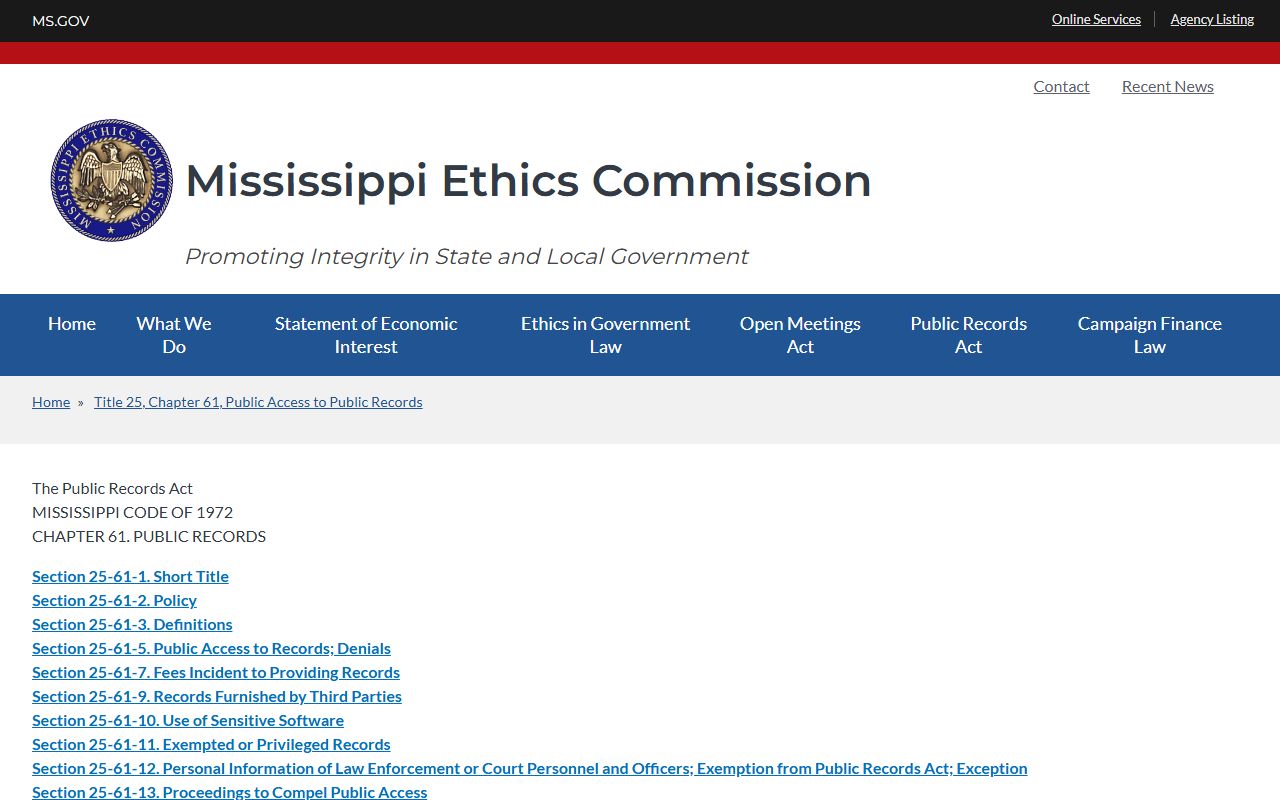 The same policy makes clear that moving records to electronic systems must not erode the public's ability to inspect them, which is the legal backdrop for MEC and PAMEC access to Circuit Court files.
Reaching a case online takes a few steps. The process below shows the usual path for a member of the public.
- Confirm the case is a Circuit Court matter, since divorce, probate, and small claims belong to other courts.
- Open the Mississippi Electronic Courts page and select Simpson County Circuit Court.
- Sign in with a PAMEC username and password, or register first at the PAMEC online registration page.
- Search by case number or party name, then open the docket and any filings your access level allows.
- Request copies or restricted files from the Circuit Clerk when a document is not visible online.
The 13th Circuit's MEC CourtInfo page lists the Simpson Circuit Court address, phone, hours, and a glossary of docket flags such as Bench Warrant Issued, Capias Pending, Justice Court Appeal, and EXPUNGED. PAMEC's statewide helpdesk sits at P.O. Box 117, Jackson, MS 39205, and answers at 601-576-4650 or helpdesk@mec.ms.gov.
Appeals From Lower Courts to Circuit Court
The Circuit Court is both a trial court and a review court. When a person loses in Justice Court or Municipal Court, the next step is usually an appeal to the Circuit Court, where the case can be heard again. The MEC flag glossary captures this with labels like Justice Court Appeal and Municipal Court Appeal, which mark cases that climbed from a lower bench. Where a county has a County Court, its rulings also rise to the Circuit Court for review.
From the Circuit Court, the road continues upward. A losing party may take the case to the Mississippi Supreme Court, which can keep the appeal or send it to the Court of Appeals. Convictions that qualify for relief follow a different track: a person may petition the court of conviction to expunge certain records under Miss. Code Section 99-19-71. A granted order can remove a qualifying case from ordinary public view, which is why some Circuit Court files carry the EXPUNGED flag.
Finding Simpson County Circuit Court Records
Local court business in Simpson County runs out of the courthouse in Mendenhall. The Circuit Court office and the Circuit Clerk share a public counter, a phone line, and standard weekday hours. Walk-in visitors, mail requests, and phone calls all reach the same office, and that office is the surest channel when a record does not appear online or sits in an older file.
Simpson County Circuit Court
100 Court Street, Ste. 2
Mendenhall, MS 39114
Phone: 601-847-2474
Hours: 8 a.m. to 5 p.m.
Several channels reach Circuit Court records, and the right one depends on the file. The list below sorts the main options.
- Online through MEC and PAMEC for Circuit Court dockets and filings, with a login.
- In person at the Circuit Clerk's counter in Mendenhall during business hours.
- By phone at 601-847-2474 for case questions and copy requests.
- By mail to the Circuit Clerk at PO Box 307, Mendenhall, MS 39114.
- By formal public-records request to the clerk that holds the file.
Note: certified copies and sealed or expunged matters must come from the Circuit Clerk directly, because those records are not available through an open online search.