
Simpson County Arrest Records and Court Charges
An arrest record in Simpson County documents the arrest itself. It notes who made the arrest, the date, the alleged offense, and the booking that follows. Most arrests here begin with the Simpson County Sheriff's Department, which acts as the county's chief law-enforcement agency and jailer. The Sheriff pursues and apprehends people charged with crimes, takes them into custody, and can take bonds for bailable felony arrests. An arrest by itself proves nothing. It records a law-enforcement action, not a court finding of guilt.
The court charge record is a different document. After an arrest, a prosecutor reviews the case and decides the formal charges, which then get filed with the court clerk. Those filed charges, with their codes and current status, become the charge record the court tracks. Booking detail and live custody status sit on the jail side, so the inmate records page covers the roster and booking questions. The full case file, with pleas, hearings, and the final outcome, is laid out in the county criminal court records. Court charges after arrest sit between those two record sets.
How to Find Simpson County Arrest Records
Simpson County does not run its own public case-search website. Felony and other Circuit Court charges route through Mississippi Electronic Courts, the statewide e-filing and case system. Public viewing runs through Public Access to MEC, known as PAMEC, which requires a registered login. The 13th Circuit Court District posts Simpson County Circuit Court detail on its MEC information page. Misdemeanor and traffic charges are Justice Court matters, and that court does not publish an online search.
- Register for a PAMEC account online if you do not already have a login.
- Choose the correct court, such as Simpson County Circuit Court, then search by defendant name or case number.
- Open the case and read the list of charges filed against the defendant.
- Check each charge for its statute code, severity level, and current status.
When a charge is not online, restricted, or held by a lower court, the fallback chain matters. Call the Circuit Clerk for Circuit Court charges. Call the Justice Court for misdemeanor, traffic, and small-case charges. For arrest and booking questions, contact the Sheriff's Department. A formal public-records request under state law can be sent to whichever office holds the record.
Simpson County Circuit Court joined Mississippi Electronic Courts in early 2019, and the statewide system now reaches every county. That does not mean every charge is free to view without a login or that every lower-court matter appears online. Justice Court remains a phone-first office. Defendants can call the Justice Court about ten days before a set court date to confirm a fine amount or arrange a trial date. Older charges and sealed files often require a direct call or visit to the clerk who maintains them.
Who Files Simpson County Charges
Charges in Simpson County usually begin with an affidavit. Private citizens and law-enforcement officers file these sworn statements to open a criminal case. Several agencies make arrests and bring charges across the county.
- Simpson County Sheriff's Department
- Mississippi Highway Patrol
- Mississippi Department of Wildlife and Fisheries
- Mississippi Department of Transportation
- Mississippi Bureau of Narcotics agents
- County constables
Who prosecutes a charge depends on its level. Felonies go to District Attorney Chris Hennis, who represents the State in the 13th Circuit District and presents cases to the grand jury. Felony categories the office handles include murder, manslaughter, sex crimes, aggravated assault, arson, kidnapping, robbery, burglary, grand larceny, fraud, forgery, false pretenses, embezzlement, identity theft, felony DUI, and drug crimes. As a general rule, a crime that can bring a year or more in jail is a felony.
Misdemeanors and traffic tickets follow a different path. The District Attorney does not prosecute speeding tickets or other misdemeanors. Those are handled in Justice Court and prosecuted by the County Prosecuting Attorney, who is appointed by the Board of Supervisors. Knowing this split tells a reader which office to call about a given charge.
Note: An affidavit or arrest starts a charge, but only a court can turn that accusation into a conviction through a plea or a verdict.
How Simpson County Charges Get Filed
The charge record begins when a charging document is filed. That document names the offense and formally accuses the defendant. Mississippi uses three main types, and the one chosen depends on how serious the offense is and how the case reaches the court.
| Complaint | Information | Indictment | |
|---|---|---|---|
| Filed By | Officer / Prosecutor | Prosecutor | Grand Jury |
| Common For | Misdemeanors | Many felonies | Serious felonies |
| Starts | The case | The case | The case |
An indictment is returned by a grand jury, a panel that reviews evidence in private and decides whether enough exists to charge a felony. A complaint or information can move faster, which is why lesser offenses often start that way.
Simpson County Charge Codes and Levels
Every charge ties back to a statute. The charge record lists the code so a reader can see exactly which law the State says was broken. Severity drives nearly everything that follows, from which court hears the case to who prosecutes it. One arrest can produce several separate charges, each with its own code and its own status.
- Felony
- A serious crime that can carry a year or more in jail or prison, prosecuted in Circuit Court by the District Attorney.
- Misdemeanor
- A lesser offense, such as many traffic and public-order violations, usually heard in Justice Court or a municipal court.
- Infraction or Citation
- A minor violation, often a traffic ticket, resolved by a fine or a short Justice Court appearance.
Simpson County Charge Status
A charge is not frozen once it is filed. As a case moves, charges can be amended, reduced, added, dropped, or dismissed. The Simpson County Circuit Court case system uses status flags to show where each charge stands. Reading those flags correctly prevents the common mistake of treating an old or dropped charge as if it were a conviction.
| Status | What It Means |
|---|---|
| Pending | The charge is filed and the case is active, with no final outcome yet. |
| Amended / Reduced | The charge has been changed, often to a lesser offense, by plea or motion. |
| Dismissed | A judge has ended the charge, which can happen for legal or evidentiary reasons. |
| Nolle Prosequi | The prosecutor has formally chosen not to pursue the charge. |
Other flags show up on the docket too, including Arraignment Pending, Bench Warrant Issued, Capias Pending, and Nolle Pros Pending. A dropped charge means the State stopped pursuing it before any conviction, so it should never read as a guilty result.
Statewide Charge and History Lookups
Some Simpson County charges roll up into statewide records that anyone can search. The Mississippi Department of Public Safety runs the state sex-offender registry, which lists people required to register after qualifying convictions. The Mississippi sex offender registry lets users search by name, by ZIP code, or by distance from an address after accepting its conditions.
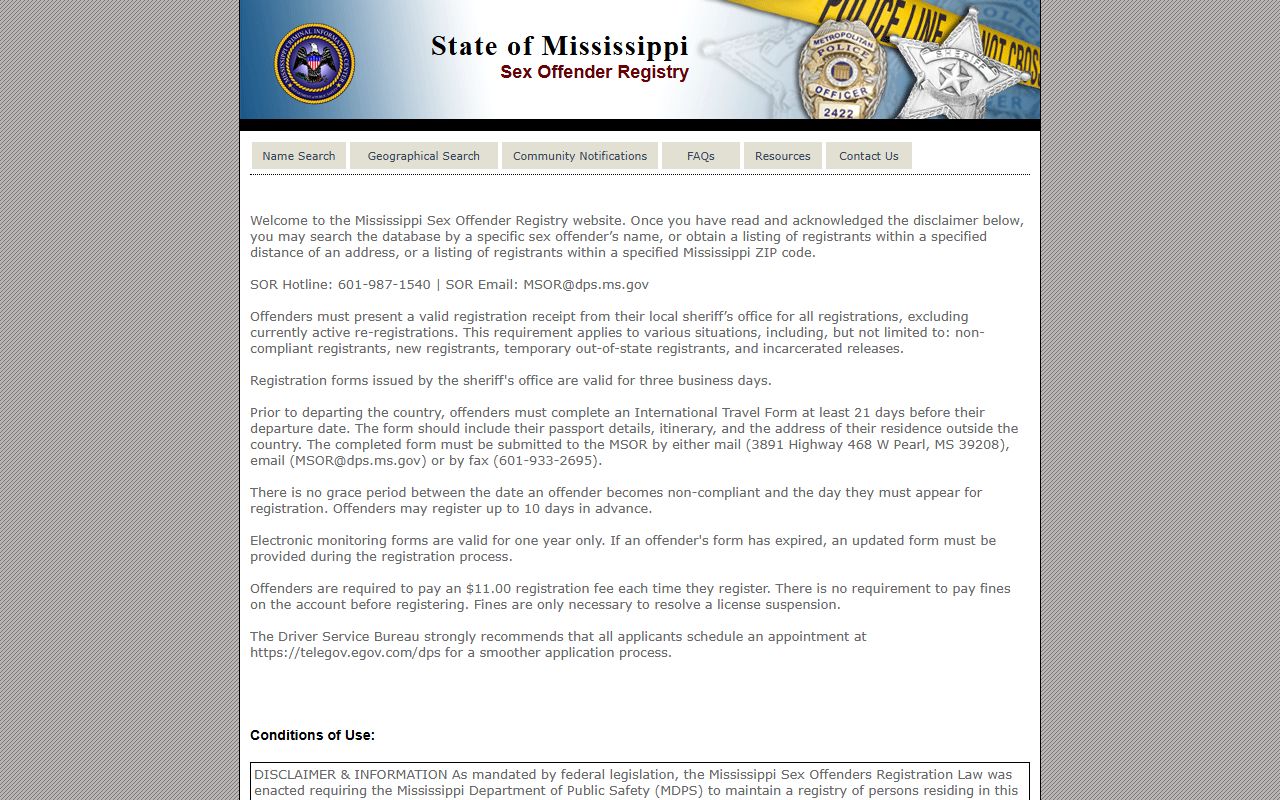
The registry is a conviction-based tool, not an arrest blotter, so it shows only people already convicted and ordered to register. For someone serving a state prison sentence, the Mississippi Department of Corrections inmate locator is the right resource. County jail custody is a separate matter and is confirmed through the Sheriff, not the state agency.
A Simpson County arrest does not put a person into state prison records right away. People awaiting bond, an initial appearance, an indictment, or a local sentence are usually in county custody. The state corrections system holds only offenders already sentenced to its care. Matching the right tool to the right stage keeps a search accurate and avoids reading the wrong record as a final result.
Charges vs. Convictions
Being charged is not the same as being convicted. A charge is an accusation that the State must still prove. A conviction is a finding of guilt, reached by a plea or a verdict. Both can appear in public records, which is exactly why an arrest record or an open charge should never be read as proof of guilt.
| Charge | Conviction | |
|---|---|---|
| Stage | Accusation | Verdict or plea |
| Burden of Proof | Probable cause | Beyond reasonable doubt |
| Public Record | Yes | Yes |
Simpson County Charge Record Access
Most criminal charge records in Mississippi are open to the public. The Mississippi Public Records Act treats public records as available for inspection unless another law makes them exempt. Court files still follow court rules, sealing orders, and redaction requirements. Access starts with the office that holds the record, which for filed charges is the clerk of the court that created the file.
Several laws pull specific records out of public view. Section 25-61-1 states the open-records policy, while Section 99-19-71 lets eligible people petition to expunge qualifying misdemeanor and felony convictions. Youth-court records are confidential under Section 43-21-251 and Section 43-21-261. Mental-health treatment records are protected under Section 41-21-97.
Note: A charge that was later expunged or sealed should not appear as an ordinary public conviction, and the court docket may carry an EXPUNGED flag.
Sealed vs. Expunged Records
Sealing and expungement both limit public access, yet they are not the same. A sealed record is hidden from public view but still exists. An expunged record is treated as if it never happened. In Mississippi, expungement is requested by petition in the court where the conviction was entered.
| Sealed | Expunged | |
|---|---|---|
| Visibility | Hidden from public | Destroyed / treated as never existed |
| Law Enforcement | Limited access | Very limited |
| Eligibility | By court order or statute, such as youth matters | Certain first offenses under Section 99-19-71 |
Restricted Simpson County Charge Records
Not every Simpson County charge record is open. Some categories are confidential by law, and others are withheld while a case is still active. Anyone searching should expect gaps in what shows up.
- Juvenile and youth-court charges, which are confidential under state law
- Sealed and expunged charges, which drop out of ordinary public search
- Records tied to mental-health or commitment proceedings
- Charges in ongoing investigations that have not yet been filed
- Personal identifiers such as Social Security numbers and dates of birth, which are redacted
Background Check Considerations
Casual record lookups and formal background checks are not the same thing. Looking up a name in a court system or a statewide registry is fine for personal knowledge. Using that information to decide on a job, a loan, a rental, or insurance is governed by federal law. A regulated background check must follow the Fair Credit Reporting Act and use a licensed consumer reporting agency.
Important: This website is not a consumer reporting agency under the Fair Credit Reporting Act, and its information cannot be used for employment, credit, housing, or insurance decisions.